Skip to content
passumi
Menu
← All CBLE past examsReleased by CBP

April 2023 CBLE
Questions & answers

Questions 1–20 of 80 · the first 25% of this paper

Reproduced from CBP’s released examination and answer key. Apply the regulations and reference editions used for this sitting, not necessarily today’s rules. Original wording is preserved.

Passumi is not affiliated with or endorsed by CBP. Our explanations are not displayed on this public page.

Question 1

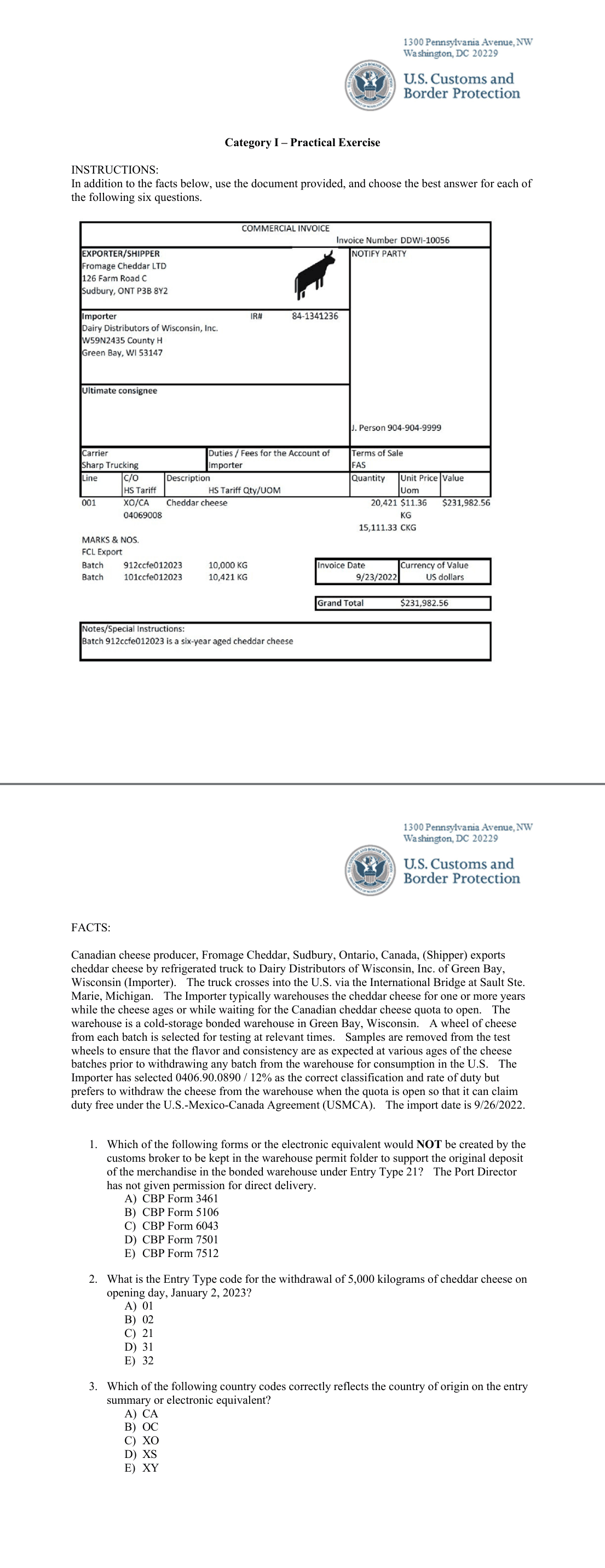
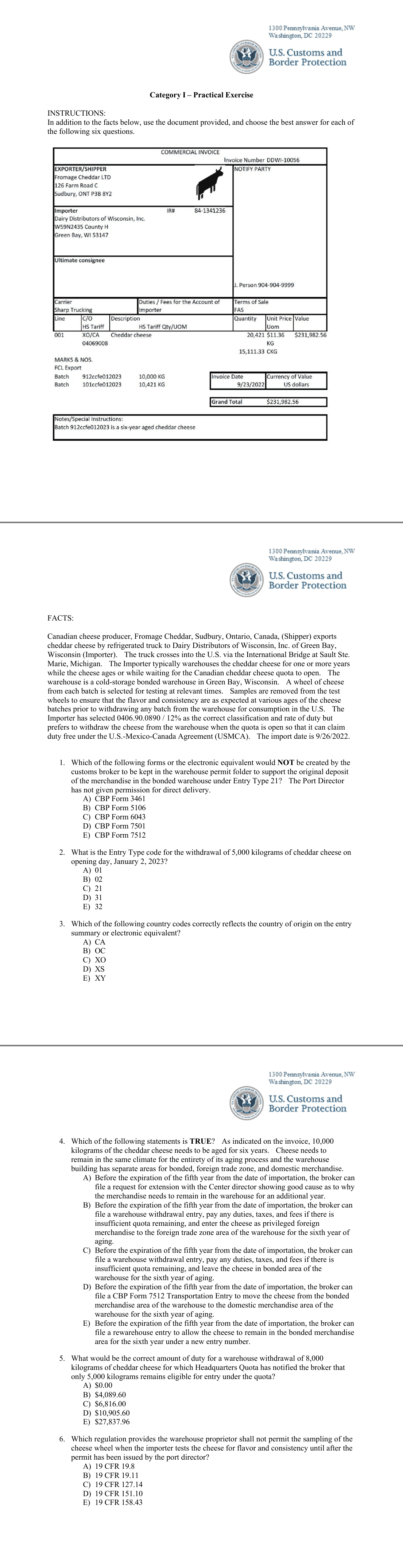
Which of the following forms or the electronic equivalent would NOT be created by the customs broker to be kept in the warehouse permit folder to support the original deposit of the merchandise in the bonded warehouse under Entry Type 21? The Port Director has not given permission for direct delivery.

Shared exhibit for Q1-6 on PDF pp.3-4; exported pages: PDF pp.3-4
  1. A

    CBP Form 3461

  2. B

    CBP Form 5106

  3. C

    CBP Form 6043

  4. D

    CBP Form 7501

  5. E

    CBP Form 7512

Show official answer

Accepted answer: B

Question 2

What is the Entry Type code for the withdrawal of 5,000 kilograms of cheddar cheese on opening day, January 2, 2023?

Shared exhibit for Q1-6 on PDF pp.3-4; exported pages: PDF pp.3-4
  1. A

    01

  2. B

    02

  3. C

    21

  4. D

    31

  5. E

    32

Show official answer

Accepted answer: E

Question 3

Which of the following country codes correctly reflects the country of origin on the entry summary or electronic equivalent?

Shared exhibit for Q1-6 on PDF pp.3-4; exported pages: PDF pp.3-4
  1. A

    CA

  2. B

    OC

  3. C

    XO

  4. D

    XS

  5. E

    XY

Show official answer

Accepted answer: C

Question 4

Which of the following statements is TRUE? As indicated on the invoice, 10,000 kilograms of the cheddar cheese needs to be aged for six years. Cheese needs to remain in the same climate for the entirety of its aging process and the warehouse building has separate areas for bonded, foreign trade zone, and domestic merchandise.

Shared exhibit for Q1-6 on PDF pp.3-4 (Q4-6 page continues on p.5); exported pages: PDF pp.3-5
  1. A

    Before the expiration of the fifth year from the date of importation, the broker can file a request for extension with the Center director showing good cause as to why the merchandise needs to remain in the warehouse for an additional year.

  2. B

    Before the expiration of the fifth year from the date of importation, the broker can file a warehouse withdrawal entry, pay any duties, taxes, and fees if there is insufficient quota remaining, and enter the cheese as privileged foreign merchandise to the foreign trade zone area of the warehouse for the sixth year of aging.

  3. C

    Before the expiration of the fifth year from the date of importation, the broker can file a warehouse withdrawal entry, pay any duties, taxes, and fees if there is insufficient quota remaining, and leave the cheese in bonded area of the warehouse for the sixth year of aging.

  4. D

    Before the expiration of the fifth year from the date of importation, the broker can file a CBP Form 7512 Transportation Entry to move the cheese from the bonded merchandise area of the warehouse to the domestic merchandise area of the warehouse for the sixth year of aging.

  5. E

    Before the expiration of the fifth year from the date of importation, the broker can file a rewarehouse entry to allow the cheese to remain in the bonded merchandise area for the sixth year under a new entry number.

Show official answer

Accepted answer: A

Question 5

What would be the correct amount of duty for a warehouse withdrawal of 8,000 kilograms of cheddar cheese for which Headquarters Quota has notified the broker that only 5,000 kilograms remains eligible for entry under the quota?

Shared exhibit for Q1-6 on PDF pp.3-4 (Q4-6 page continues on p.5); exported pages: PDF pp.3-5
  1. A

    $0.00

  2. B

    $4,089.60

  3. C

    $6,816.00

  4. D

    $10,905.60

  5. E

    $27,837.96

Show official answer

Accepted answer: B

Question 6

Which regulation provides the warehouse proprietor shall not permit the sampling of the cheese wheel when the importer tests the cheese for flavor and consistency until after the permit has been issued by the port director?

Shared exhibit for Q1-6 on PDF pp.3-4 (Q4-6 page continues on p.5); exported pages: PDF pp.3-5
  1. A

    19 CFR 19.8

  2. B

    19 CFR 19.11

  3. C

    19 CFR 127.14

  4. D

    19 CFR 151.10

  5. E

    19 CFR 158.43

Show official answer

Accepted answers: A, B

Question 7

Which statement correctly identifies the timeframe within which CBP will notify the importer in writing of a detention of merchandise when CBP suspects the merchandise bears a counterfeit version of a mark that is registered with the U.S. Patent and Trademark Office and is recorded with CBP?

  1. A

    Five (5) business days from the date the decision is made to detain.

  2. B

    Five (5) calendar days from the date the decision is made to detain.

  3. C

    Seven (7) business days from the date the merchandise is presented for examination.

  4. D

    Seven (7) business days from the date of the oral notification to the broker of the detention.

  5. E

    Thirty (30) calendar days from the date on which the merchandise is presented for examination.

Show official answer

Accepted answer: A

Question 8

Under which of the following circumstances will the importer NOT be required to have a bond containing conditions set forth in 19 CFR 113.62 to obtain release of merchandise under a special permit for immediate delivery?

  1. A

    An importation of quota-class merchandise.

  2. B

    An importation under an end-of-year authorization issued by CBP Headquarters.

  3. C

    An importation of goods from a contiguous country, namely Canada and Mexico.

  4. D

    A release from a warehouse followed by a warehouse withdrawal for consumption.

  5. E

    An importation by the U.S. Animal and Plant Health Inspection Service.

Show official answer

Accepted answer: E

Question 9

Which section of the Customs Regulations states the general exceptions to the marking requirements?

  1. A

    19 CFR 134.22

  2. B

    19 CFR 134.32

  3. C

    19 CFR 134.41

  4. D

    19 CFR 134.43

  5. E

    19 CFR 134.44

Show official answer

Accepted answer: B

Question 10

What is the civil fine for a first violation under 19 U.S.C. 1526(f) and 19 CFR 133.27 on any person who directs, assists financially or otherwise, or aids and abets the importation of merchandise for sale or public distribution that bears a counterfeit mark resulting in a seizure of the merchandise?

  1. A

    The fine imposed will not be more than the value the merchandise would have had if it were genuine, according to importer’s selling price in the United States of similar merchandise.

  2. B

    The fine imposed will not be more than the value the merchandise would have had if it were genuine, according to the manufacturer’s suggested retail price in the United States at the time of seizure.

  3. C

    The fine imposed will not be more than two times the value the merchandise would have had if it were genuine, according to the manufacturer’s suggested retail price in the United States at the time of seizure.

  4. D

    The fine imposed will not be more than three times the value the merchandise would have had if it were genuine, according to the manufacturer’s suggested retail price in the United States at the time of seizure.

  5. E

    Fines are only imposed on the second and each subsequent seizure and never on a first seizure.

Show official answer

Accepted answer: B

Question 11

In response to the issuance of which CBP Form, or its electronic equivalent, may Center directors accept certificates of marking supported by samples of marked articles from importers or from actual owners to certify that marking of the country of origin on imported articles has been accomplished?

  1. A

    CBP Form 3347

  2. B

    CBP Form 4647

  3. C

    CBP Form 4811

  4. D

    CBP Form 5106

  5. E

    CBP Form 5129

Show official answer

Accepted answer: B

Question 12

Which one of the following actions CANNOT be taken on merchandise after liquidation of the entry becomes final?

  1. A

    Assess a penalty under 19 U.S.C. 1592

  2. B

    File a prior disclosure

  3. C

    Demand for return of merchandise

  4. D

    File a 514 protest

  5. E

    File a 520(d) post-entry duty refund claim

Show official answer

Accepted answer: C

Question 13

What is the CLASSIFICATION of handbags that are constructed of birch wood and are valued over $20.00 each. The wood is completely uncoated and uncovered which creates a natural look. The interior of the handbags is not lined.

  1. A

    4202.21.9000

  2. B

    4202.29.2000

  3. C

    4202.29.9000

  4. D

    4202.99.2000

  5. E

    4221.99.9880

Show official answer

Accepted answer: E

Question 14

What is the CLASSIFICATION of a welded, octagonal steel tube? The tube consists of 0.8% Carbon and 10.3% Chromium and has a wall thickness of 3.8 mm.

  1. A

    7304.90.3000

  2. B

    7304.90.5000

  3. C

    7306.61.7060

  4. D

    7306.69.7030

  5. E

    7306.69.7060

Show official answer

Accepted answer: E

Question 15

What is the CLASSIFICATION of a printer that connects to an automatic data processing machine, transmits a facsimile, copies, and prints at a speed of 30 pages per minute?

  1. A

    8443.31.0000

  2. B

    8443.32.1010

  3. C

    8443.39.4000

  4. D

    8471.49.0000

  5. E

    8472.90.9080

Show official answer

Accepted answer: A

Question 16

What is the CLASSIFCATION of a men’s lace-up, casual shoe with a closed toe and closed heel that does not cover the ankle with an upper of 100 percent (100%) manmade textile material and an outer sole of 100 percent (100%) rubber. The shoe does not have foxing or a foxing like band and is valued at $21 per pair.

  1. A

    6404.11.9020

  2. B

    6404.19.3040

  3. C

    6404.19.8930

  4. D

    6404.19.9030

  5. E

    6404.19.9060

Show official answer

Accepted answer: D

Question 17

Which answer describes a material which is classifiable within Heading 5903, HTSUS?

  1. A

    A bonded textile fabric that consists of three layers. The first layer a woven face fabric, the second layer is a plastic glue (used to bond the fabrics) and the third layer is a woven backing fabric. The plastic glue is not visible to the naked eye.

  2. B

    A textile fabric which is coated on one side with plastics, bearing a design as a result from the coating treatment.

  3. C

    A quilted textile fabric, laminated with a plastic material on one side and imported in the piece.

  4. D

    A plain-woven textile fabric wholly of polyester filament fibers.

  5. E

    A woven textile fabric which has been laminated on one side with a film of plastic. The laminated fabric will be used in the manufacture of jackets.

Show official answer

Accepted answer: E

Question 18

What is the CLASSIFICATION of a whoopee cushion, which is a seat cushion commonly placed on a seat for humor purposes that makes a sound resembling human flatulence when compressed?

  1. A

    3926.90.7500

  2. B

    4016.99.6050

  3. C

    9401.80.2031

  4. D

    9503.00.0090

  5. E

    9505.90.2000

Show official answer

Accepted answer: E

Question 19

What is the CLASSIFICATION of an unassembled, complete, commercial greenhouse building made predominantly of wood with subsidiary translucent plastic panels?

  1. A

    4421.99.9880

  2. B

    9406.10.0000

  3. C

    9406.90.0110

  4. D

    9406.90.0120

  5. E

    9406.90.0190

Show official answer

Accepted answer: B

Question 20

What is the CLASSIFICATION of a flat piece of marble which has been surface-polished but not edge-worked, and measures 30 centimeters long by 30 centimeters wide by 3 centimeters thick?

  1. A

    2515.12.1000

  2. B

    2516.90.0060

  3. C

    6802.21.5000

  4. D

    6802.91.0500

  5. E

    6802.91.1500

Show official answer

Accepted answer: D

Remaining questions locked

Questions 21–80

The rest of this paper is available in the mock exam with an eligible entitlement. You can start or resume the free portion now; paid access is not on sale yet.

Continue in the mock exam →